
One Standard, Two Prophets — Part III: The Cave and the Road
In Part I, I made a deal: four criteria, stated at full strength, one detector, both men walk through, nobody switches off the machine for a friend. In Part II we ran the first alarm, lateness, and it barely whispered for Paul: twenty-five years, a creed dated by atheist scholars to within three years of the crucifixion, and a chain short enough to hold in one sentence. For Muhammad, the alarm sent the entire neighborhood into panic mode: six hundred years of distance, and hadith collections written down another two hundred years after him. That’s not late; that’s chronologically stranded.
If you’re just joining, start from Part I; the rules live there.
You can also watch the YouTube video for Part I here, and the video for Part II here.
Today, the second alarm: no contact.
Paul never met Jesus. Not once. He never sat in the circle, never heard a parable explained over dinner, never walked a dusty mile behind him. He barely even knew what his sandals looked like. His entire connection to Jesus is an experience he had on a road to Damascus, an encounter nobody can verify, in his head, on his word (at least in the seven undisputed letters of Paul that we agreed to use). And at the end of Part II, I promised we’d deal squarely with what a private revelation can and cannot establish. It’s time to do just that.
Visions are cheap

Let me re-state the objection at full strength, and honestly, it’s a good one.
Visions are the cheapest currency in religion. They cost nothing to claim, they can hardly be verified, and they conveniently appoint the visionary to management. History is littered with them. Every era, every continent, every family has one. You have an uncle, I’m sure of it, who once dreamt something tremendous about his own destiny, and the only lasting result was a long speech at a family gathering.
A Muslim apologist will sharpen this into a blade, and it may cut clean: if you accept Paul’s unverifiable vision, why not Joseph Smith’s golden plates? Why not every man who ever came down from a mountain with shining eyes and a new set of rules? You laugh at their visions and canonize Paul’s. One standard, remember?
Yes. One standard. I built this detector, and I’m not about to crawl under it.
So I’ll state the standard again plainly and hold both men to it:
“A private experience, by itself, establishes nothing for anyone except the person who had it.”
It cannot be cross-examined. It cannot be checked.
If a religion asks me to believe based on what one man says happened to him alone, with nothing outside his own head to anchor it, then that religion is asking for something no honest mind should hand over on demand. It’s like a guy dropping a voice note in the group chat claiming he’s got a guaranteed crypto strategy that will buy everyone a condo in San Francisco. No screenshots, no portfolio, and no one else to back him up. He says the whole algorithm just “flashed into his head” while he was at a beach, alone.
You wouldn’t even send him $20 based on his solo daydream. So why would you hand over your entire belief system?
That’s the entire point, and I agree with it. Completely.
Which is why it matters enormously that Christianity does not rest on Paul’s vision. And why it matters even more that, when we walk this same alarm to the other end of the line, Muhammad’s line, we’re going to find a faith that rests on nothing else.
What Paul actually claimed
Go back to the creed from Part II, the one dated to within a few years of the crucifixion, and look at where Paul puts himself in it:
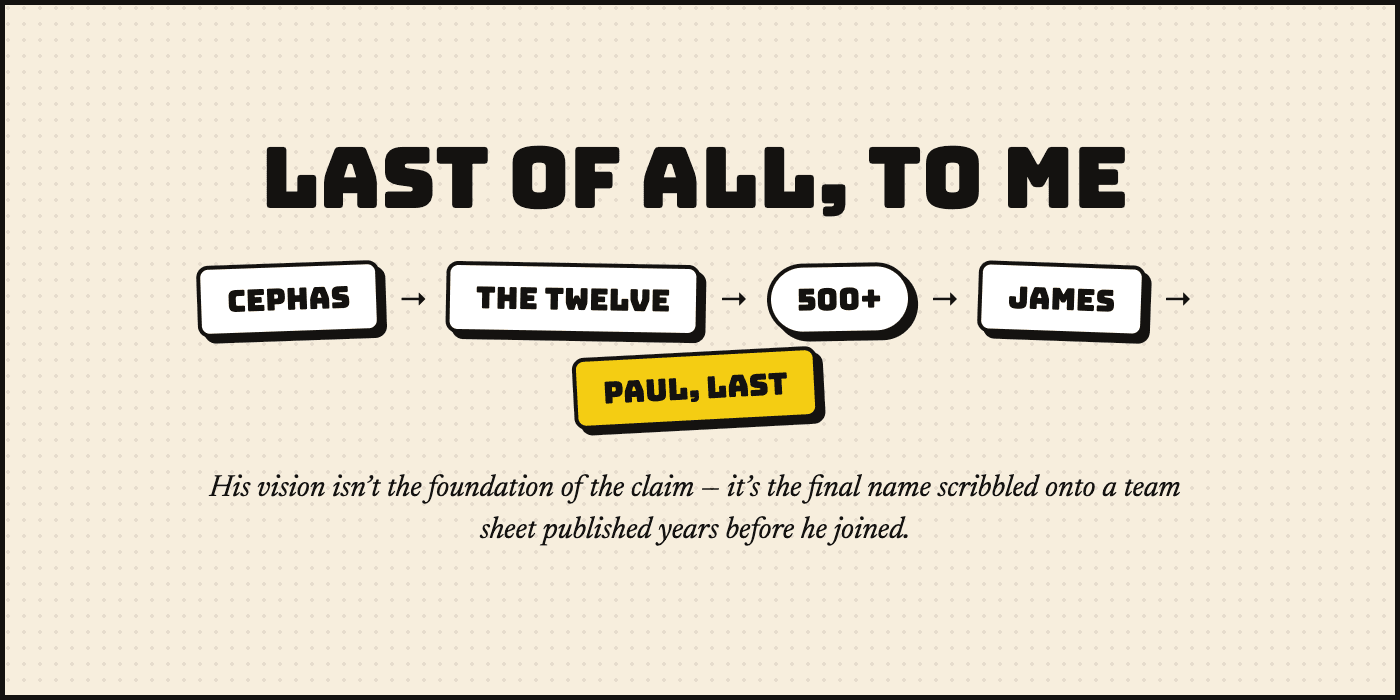
“…he appeared to Cephas, and then to the Twelve. After that, he appeared to more than five hundred of the brothers and sisters at the same time, most of whom are still living… Then he appeared to James, then to all the apostles, and last of all he appeared to me also, as to one abnormally born.”
Read that placement carefully, because it is the whole argument.
Paul does not say “Jesus appeared to me, and therefore Christianity is true.” He appends himself to the end of an existing list. Last of all. After Peter. After the Twelve. After five hundred people at once. After James. His experience is not the foundation of the claim; it is the final name scribbled onto a team sheet that was published years before he joined. He was the final player called up to join an already formidable squad. The resurrection was already being proclaimed, by named living witnesses, in the city where it happened, while Paul was still busy arresting people for proclaiming it.
Think about what that means for the weight his vision has to carry. If a man tells you something no one else on earth has ever claimed, and his only evidence is a dream, then everything rests on the dream, and you are right to walk away. But if a man tells you he has come to believe a claim that five hundred living people were already making in public, his private experience isn’t carrying the claim. It’s carrying him. The Damascus road is not the evidence for the resurrection. It is the story of how the resurrection’s most dangerous enemy switched sides.
Here’s another way to feel the difference. Imagine a man announces he won a lottery nobody else has heard of, no draw, no ticket, no numbers, just his word. That’s one hell of a claim, isn’t it? Now imagine another man announces that he’s just realized that the publicly drawn, published, and witnessed lottery numbers match a ticket he’d been refusing to check. The second man’s realization happened privately too. But the draw was public. Paul’s road conversion is the second kind of story. Muhammad’s cave revelation, as we’ll see, is the first.
Remove Damascus and see what’s still standing
Don’t take my word for it. Let’s run the demolition test together.
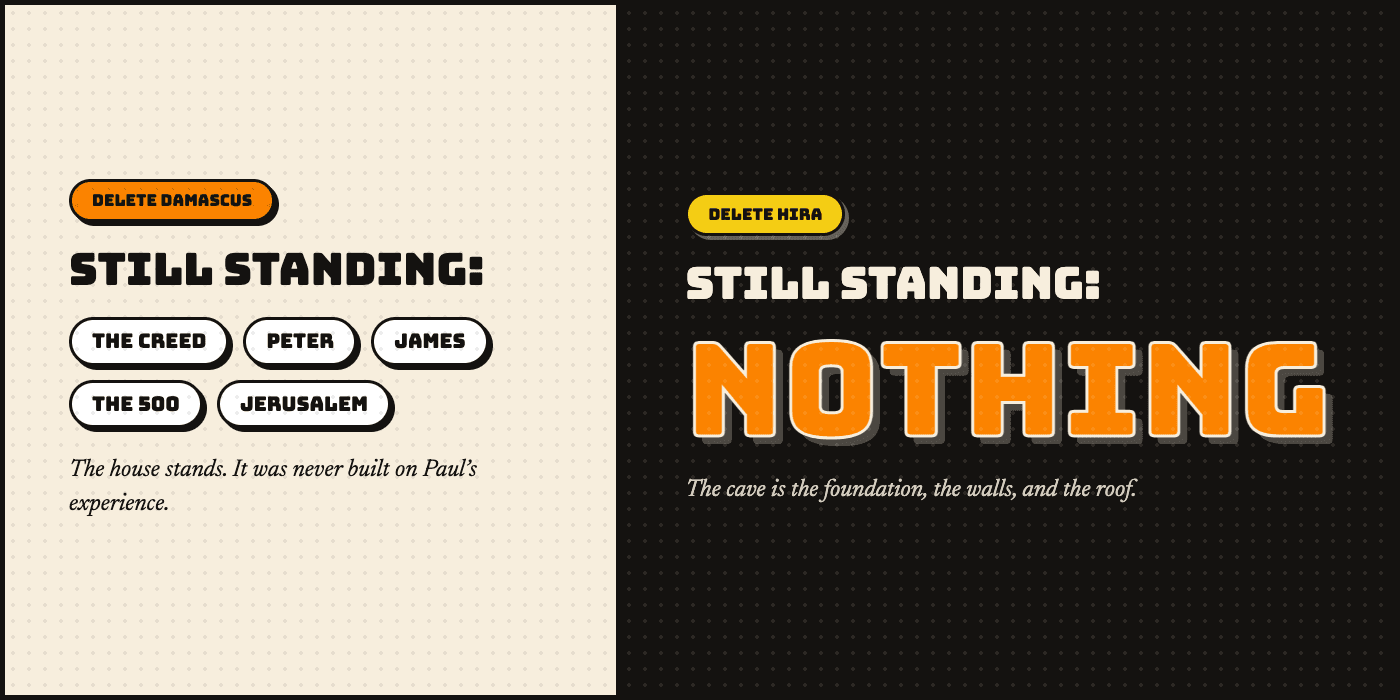
Delete Paul’s vision from history entirely. Scrub the Damascus road out of every record. What’s left?
The creed is still there, still dated to within a few years of the cross, because Paul received it; he didn’t write it. Peter is still there, still proclaiming what he saw. James is still there, a skeptical brother turned leader of the Jerusalem church. The five hundred are still there, most still living, still checkable. The Jerusalem community is still there, worshiping a crucified man as risen Lord within shouting distance of his tomb, under the noses of the authorities who arranged the crucifixion.
Christianity would lose its greatest missionary and thirteen letters’ worth of theology, but not its foundation. The house stands, because the house was never built on Paul’s experience. Paul’s experience is just the story of how one very hostile man ended up inside the house.
Now hold that thought, because in a few minutes we’re going to run the same demolition test on Muhammad in the cave of Hira, and I want you to watch very closely what’s left standing there.
The vetting and the bill
Two more things about Paul’s vision, and then we cross the line to Muhammad.
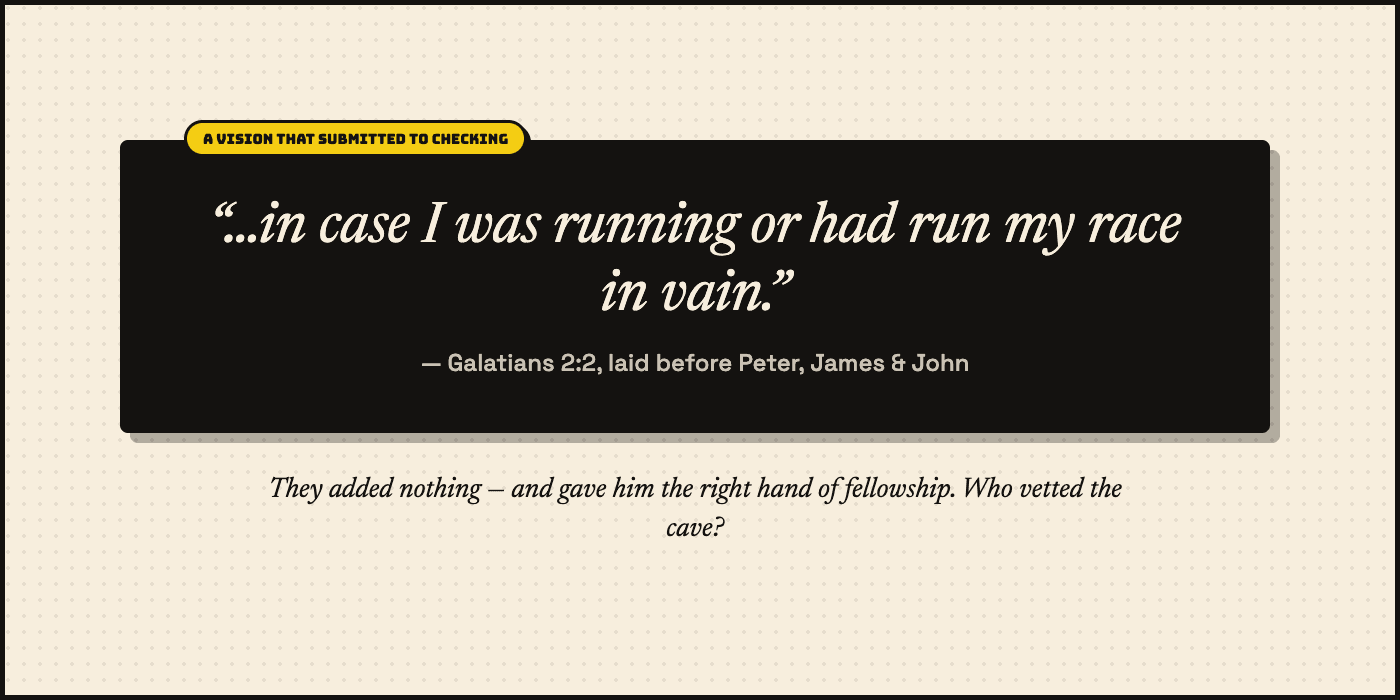
First, the vetting. Paul did not treat his private experience as self-certifying, and this detail is criminally underrated. By his own sworn account in Galatians, he went to Jerusalem and laid his gospel before Peter, James, and John, the men who had actually walked with Jesus, “in case I was running or had run my race in vain” (Galatians 2:2). Let’s investigate that closely. Here is a man supposedly drunk on his own revelation, admitting in writing that his revelation needed checking against the eyewitnesses, and that it could, in principle, have failed the check. It didn’t. They “added nothing” and gave him the right hand of fellowship. A private experience, submitted to public witnesses, and endorsed: that is exactly what intellectual honesty looks like when a vision shows up claiming things.

Second, the bill. I keep a simple rule for evaluating testimonies, revelations and visions: check what it costs the man. People fabricate visions for money, for power, for wives, for status. Paul’s vision cost him every single one of those. He was the rising star of his generation, trained under Gamaliel1, credentialed, connected, feared. He itemizes what the vision earned him instead: five times the forty lashes minus one, three times beaten with rods, once stoned and left for dead, three shipwrecks, hunger, cold, prison (2 Corinthians 11:24–27). He calls his old credentials “loss” and, in the Greek, something closer to dung (Philippians 3:8). The man who once held the coats at executions ended up on the receiving end of the stones.
None of this proves the vision was real. Sincere people suffer for false beliefs all the time; sincerity is evidence of conviction, not of truth. But it annihilates the standard motive for fabrication. Whatever happened on that road, Paul wasn’t selling it. He was paying for it, in installments, for thirty years, and the final payment was his head.
So tally the second alarm for Paul, honestly. A private experience? Yes, and I won’t pretend otherwise2. But one that carries no foundational weight (the faith predates it and survives without it), was submitted to eyewitness vetting (and passed), converted the claim’s fiercest enemy (against every earthly interest he had), and attached itself to a public event with named, living, checkable witnesses.
The alarm sounds, faintly, as it should for any vision. Then the guard notices what the vision is bolted to (you know, like an expensive watch or something), and lets him through, no issues.
The same detector, the cave
Now, the other man. Same machine. Same setting.
Mecca, around the year 610. A man named Muhammad, forty years old, respected, known to his people as trustworthy, retreats to a cave on the mountain of Hira to pray3, as was his habit. And there, according to the earliest Islamic sources, something overwhelming happens. A presence, later identified as the angel Gabriel, seizes him and commands him: Recite. He is terrified4. He flees down the mountain to his wife Khadija, trembling, crying “cover me, cover me.” She consoles him. Her cousin Waraqa5, an old Christian, hears the account and tells him he has received something like what came to Moses.
It is a story told seriously, and the terror in it rings human and true. But now I have to ask the same two questions I asked of Paul, the same two you’d ask about the wedding story from Part II, and I need you to notice the answers.
Who else was in the cave? No one.
Who vetted the content of the experience against something they themselves had witnessed? No one, because there was nothing anyone had witnessed. Khadija believed her husband. Waraqa, who was old and blind, believed the report. Their trust is touching, and it is exactly that: trust in a report. The first validators of the cave never saw the cave’s contents. They merely saw a shaken man they loved, and they took his word. Twelve years later comes the Night Journey, Muhammad carried by night to Jerusalem and through the heavens (Surah Al-Isra 17:1), and again the witness list has exactly one name on it. You guessed it.
Now run the demolition test, the same one we ran on Damascus. Remove the cave. Remove the Night Journey. Remove Muhammad’s private encounters with Gabriel.
What is left of Islam?
Not a reduced Islam. Not an Islam minus its best missionary.
Nothing.
Every verse of the Quran, every doctrine, every practice, every claim about Jesus made six centuries after the fact, all of it enters history through one channel: the private, unwitnessed experiences of one man. There is no prior public event. No pre-existing community of witnesses making the claim before he arrived. No list of five hundred for him to append his name to. No pillars for him to submit his revelation to, in case he had believed in vain. The cave is not a doorway into a house that was already standing, the way Damascus was. The cave is the foundation, the walls, and the roof. If the cave crumbles, so goes Islam.
So here is the question, and it is not a gotcha; it is the same question from the top of this essay, pointed the other way. If a private experience, by itself, establishes nothing for anyone except the person who had it, and if that standard was strong enough to throw at Paul, whose faith does not rest on his vision, what does the same standard do to a faith that rests on nothing else?
“But the Quran itself is the miracle”
The thoughtful Muslim from Part I has been patient, and he steps in here with his best answer, and it is genuinely his best. He says: you’ve misunderstood us. We don’t believe Muhammad because of the cave. We believe him because of what came out of it. The Quran itself is the evidence: its unmatched eloquence, which no one has equaled though the challenge stands open (Surah Al-Baqarah 2:23), its perfect preservation, the way it turned scattered feuding tribes into a civilization within a century. The proof is not the vision. The proof is the book.
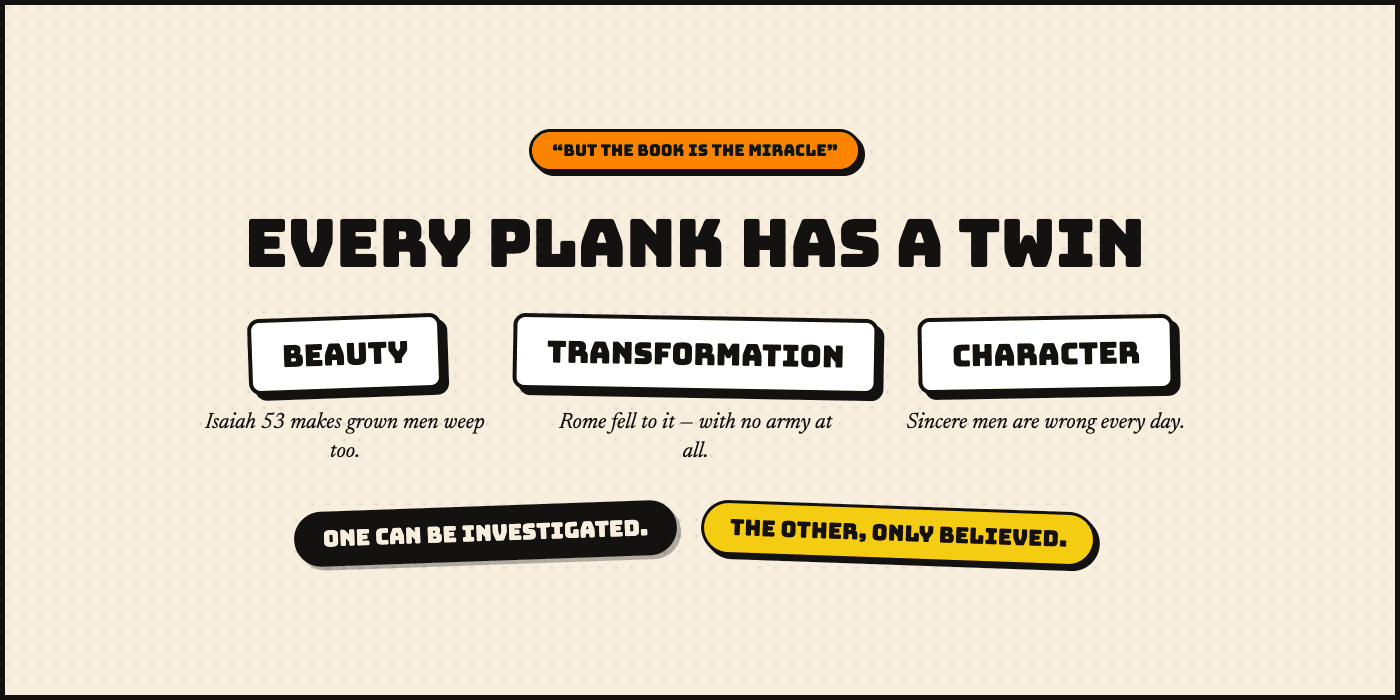
I would like to honor that, because it’s a real argument for Muslims and it deserves a real answer. And my answer is quite simple. Every plank in it proves too much or too little, because every plank has a Christian twin the Muslim already rejects.
Beauty and Inimitability? I’ll happily grant the Quran its literary power (whether I agree or not); Arabic speakers across fourteen centuries are not all pretending. But I’ve watched grown men weep at Isaiah 53 and the Sermon on the Mount, and a billion Christians find in those words a majesty that no human pen explains. Does their experience validate my book for you? No? Then we’ve learned something important: the beauty of a text is testimony from the already convinced. It is a congregation applauding its own choir. If eloquence proved inspiration, we would both be right, and we can’t both be right.
And I haven’t forgotten the challenge itself, because I know “beauty” undersells the claim. The claim is that the Quran is inimitable, and the proof offered is an open dare: produce a surah like it (Surah Al-Baqarah 2:23), and in fourteen centuries none has been produced. Let’s say fine. But walk up to that test the way you’d walk up to any test, and ask the ordinary questions. Who judges whether the challenge has been met? What agreed features must a rival text reproduce? What result would ever allow a Muslim judge to say, “Yes, that surah equals it; the challenge has failed”? There are no answers on file. Every attempt across fourteen centuries has been declared a failure, every single time, by judges formed inside the tradition that already holds, as doctrine, that failure is guaranteed6. That is not a test; that is a contest in which the home team appoints the referee, writes the rules, and declares every shot offside. An unfalsifiable dare doesn’t prove a book divine. It proves the scoreboard belongs to the stadium owner.
Transformation? Islam turned Arabia around in a century, with armies and a state (and quite honestly, I respect Muhammad as one of the greatest statesmen to have ever lived, just like Cyrus the Great and Otto von Bismarck7). However, Christianity turned the Roman Empire upside down in three centuries with no army at all, with its founder executed, and with its first three hundred years spent intermittently fed to lions8. If transforming a civilization certifies a revelation, then mine is certified twice over, and yours must accept it. If it doesn’t certify mine, it cannot certify yours. Pick one; the detector insists.
Character? Muhammad was called “al-Amin”, the trustworthy, and I have no interest in disputing it. But Paul was, by all accounts including his enemies’, sincere unto death, and so were Peter and James, and the objection we started with never accepted sincerity as proof. Rightly so. Sincere men are wrong every day. If “he was known to be honest” settles it, the standard has quietly changed mid-line, and someone’s hand is on the detector’s off switch.
Notice the pattern. Every validator offered for the cave is a validator the Muslim declines to accept when it’s offered for the cross. And when all the shared planks cancel out, each faith is left holding only what is uniquely its own. What Christianity uniquely holds is a public claim, a specific dead man seen alive, staked on named living witnesses, in the city of the execution, within weeks of it. What Islam uniquely holds is the cave.
“One of these can be investigated. The other can only be believed.”
Full disclosure
Now the part where I show you my own cards, because this series dies the day I start hiding them.
I believe Paul’s vision was real. I believe the risen Christ actually met him on that road, and I believe it not as a historian but as a Christian; that is where I stand and you’ve known it since Part I. So am I doing the very thing I’m accusing others of, accepting my man’s vision and rejecting theirs?
Look back over the essay and check. At no point have I asked you to believe Paul’s vision on his word. Not once. The argument never leaned on it. It leaned on the creed, the dates, the named witnesses, the vetting, the bill he paid. Strip out my belief in the vision and every load-bearing beam is still standing, which is fitting, because that is exactly the shape of the faith itself. Christianity offers you a way to investigate that does not begin with trusting one man’s private experience. That is not a small difference between these two stories. It is the entire difference, and it is the whole finding of this alarm.
Two alarms down, two to go
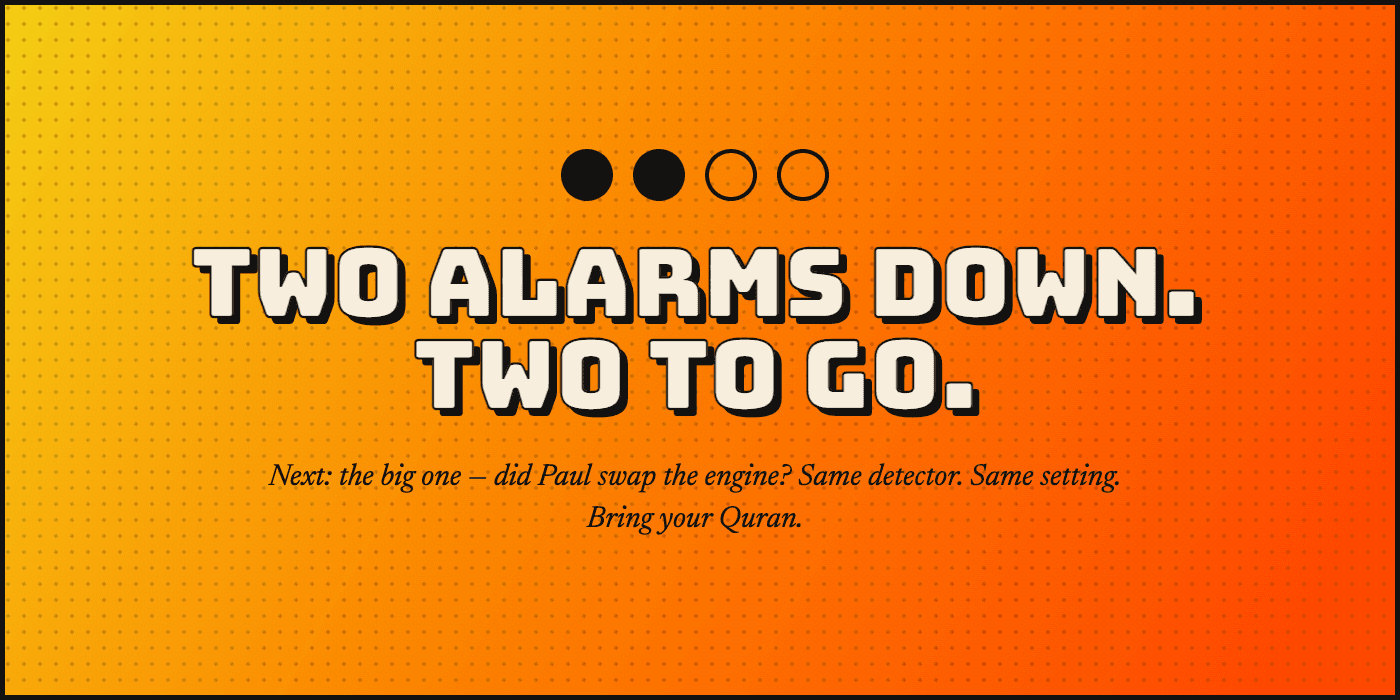
Next time, the big one, the charge that everything else has been warming up for: that Paul didn’t just join the faith, he changed it. Swapped the engine. Invented the divine Jesus, cancelled the Law, built a religion the carpenter from Nazareth would not recognize. That accusation deserves the longest run-up and the coldest examination, and it’s getting both.
“Same detector. Same setting. And this time, bring your Quran; we’ll need it open.”
Newsletter coming soon
Email signup is not connected yet, so we will not pretend to collect your address. Follow the channel for new essays and episodes in the meantime.
Follow on YouTube