
One Standard, Two Prophets — Part II: The Man Who Named Names

In Part I, I made a steelman deal in good faith. I took the four criteria Muslims use against Paul, stated them at full strength (at least in the best way I could present them without being too verbose), and promised to run both men through the same detector, at the same setting, with nobody switching the machine off for a friend. If you missed it, start there; the rules of this series live in that essay. I also followed it up with a YouTube video which you can watch here.
Today, we test the first alarm: lateness.
Paul was not there. He missed the ministry. He missed the crucifixion. He even missed the empty tomb his movement proclaimed. He arrives afterward, an outsider interpreting events he never saw, and with a lot of authority too.
“A man reporting on events he didn’t witness is only as good as his distance from them.”
I agree with that standard, by the way. Completely. Distance from the events is a real measure of reliability; historians use it every day, and so do we all. If a stranger tells you an interesting story of what happened at a wedding, your first question is some version of “were you there?” and if the response is no, your second question would naturally be “then who told you?”
So let’s ask Paul both questions, honestly, and see what he says. Then let’s ask the same two questions of the Quran’s account of Jesus according to Muhammad, and refuse to blink.
The math nobody disputes
Let’s start with the numbers, because the numbers are not controversial.
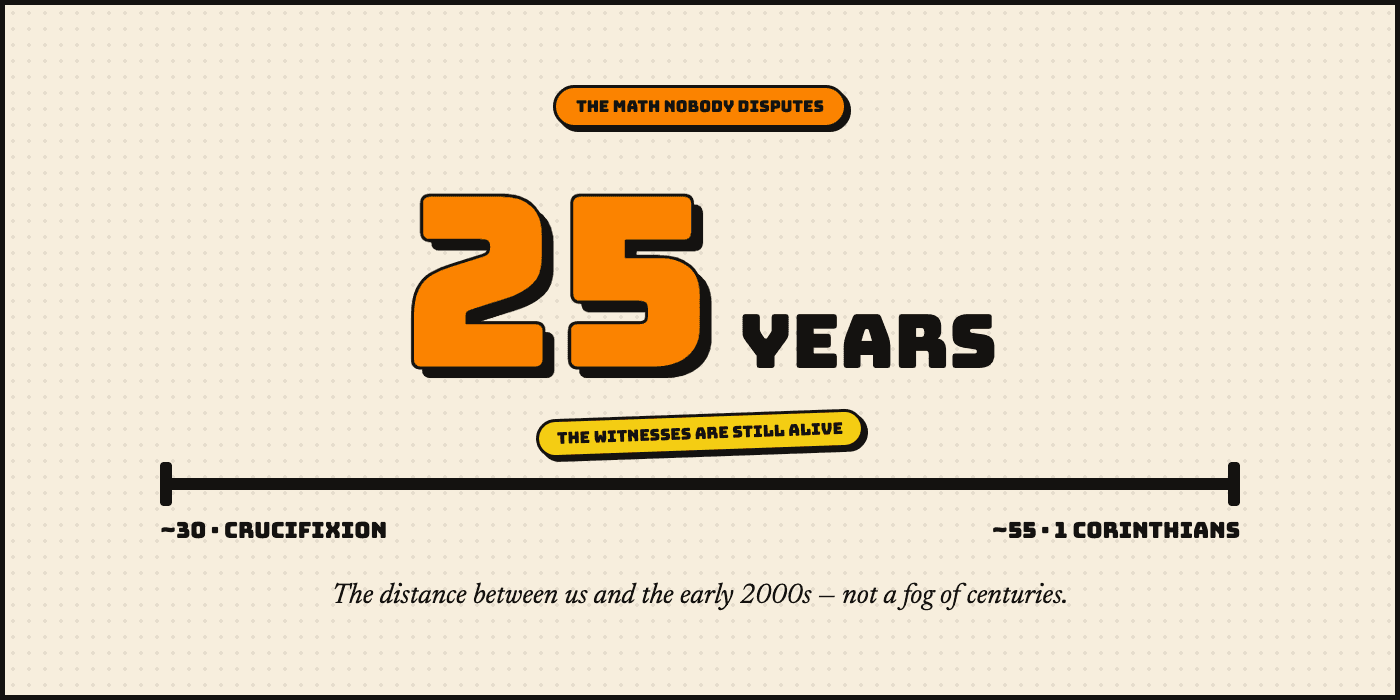
Jesus was crucified around the year 30, maybe as late as 33. Paul’s seven undisputed letters, the only documents I’m allowed to use under the rules I established in Part I, were written roughly between 50 and 57. 1 Corinthians, the letter that matters most today, is dated by scholars of every stripe to around 55 AD, which is within twenty-five years of the crucifixion.
Twenty to twenty-five years. Hold that number in your hand for a second and feel its weight. That is not ancient history. That is the distance between us and the early 2000s. That’s also roughly the distance between Lionel Messi’s performance at the 2026 World Cup and his debut at the same event. It means that when Paul’s letters were being read aloud in Corinth and Galatia, the people who had followed Jesus around Galilee were largely still alive, in their fifties and sixties, still living in the same small world of Judea, still available for questioning. Peter was alive. James, the brother of Jesus, was alive and running the Jerusalem church. Paul was not writing about a figure lost in the fog of centuries. He was writing about a man whose brother you could still go and argue with. I still remember Messi’s goal and assist against Serbia in 2006 and I am not even remotely related to the guy. You can imagine how much more James would remember about the teachings of Jesus Christ.
But it gets better than that, and this is where the lateness objection doesn’t just weaken. It flips.
The oldest words in the New Testament
Open 1 Corinthians 15, and watch what Paul does. He does not say “here is my theory about Jesus.” Here’s what he says, verbatim:
“For what I received I passed on to you as of first importance: that Christ died for our sins according to the Scriptures, that he was buried, that he was raised on the third day according to the Scriptures, and that he appeared to Cephas, and then to the Twelve. After that, he appeared to more than five hundred of the brothers and sisters at the same time, most of whom are still living… Then he appeared to James, then to all the apostles.”
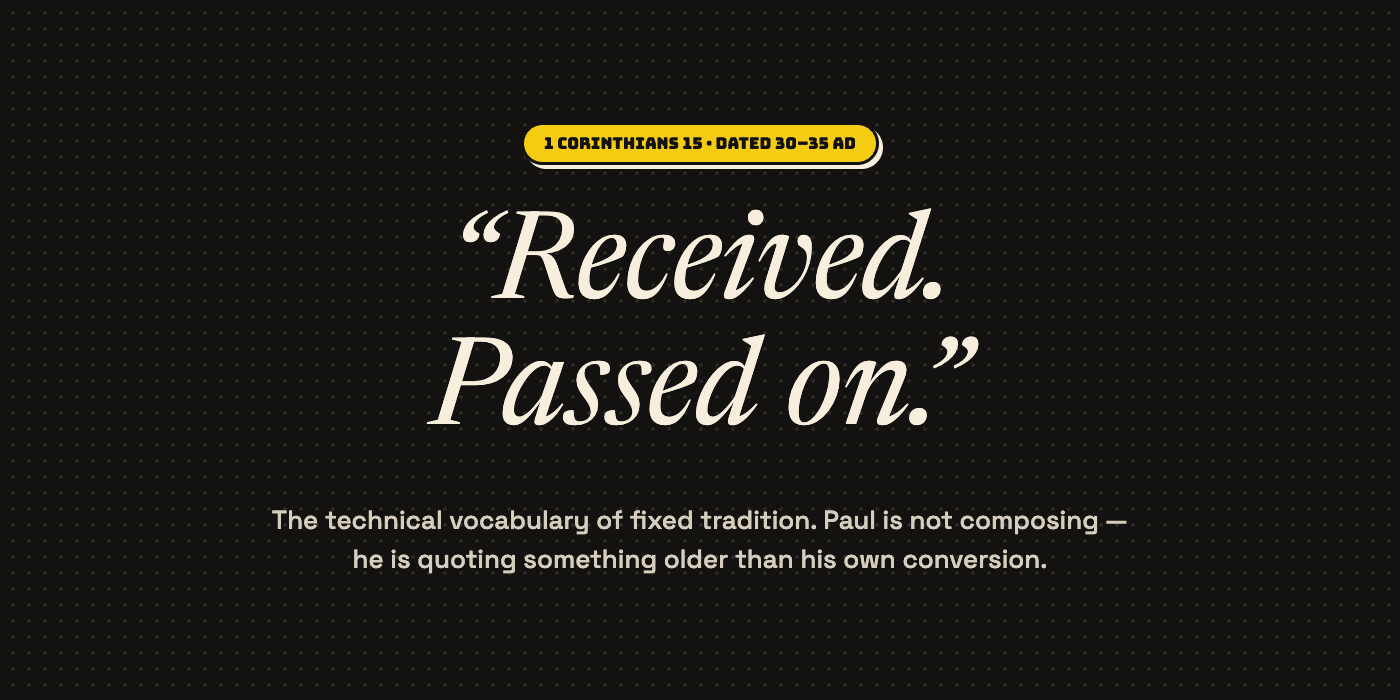
Received. Passed on. Those two words are doing enormous work, and a first-century reader would have heard them instantly. They are the technical vocabulary of formal tradition, the same paired terms a rabbi used when handing down a fixed teaching that a student was expected to memorize word for word. Paul is not composing here. He is quoting. He is reciting a creed that already existed, that someone taught him, in a form designed to be memorized.
And scholars can tell. Not because they take Paul’s word for it, but because the passage betrays itself. It uses several words Paul never uses anywhere else, it refers to “the Twelve” when Paul’s own habit everywhere else is to simply say “apostles,” and it runs in a balanced, rhythmic structure that marks early Christian creeds the way rhyme & rhythm mark a song (I used to rap, so I would know).
It reads like a quotation because that is exactly what it was. Imagine finding a paragraph of formal Elizabethan verse in the middle of a colleague’s email; you would know at once they were quoting something older than the email. That is what 1 Corinthians 15 looks like to people who read Greek for a living.
So the question stops being “when did Paul write this letter?” and becomes “how old is the thing he’s quoting?” And here is where I want you to notice whose answer I’m giving you. Not a pastor’s. Not an apologist’s.
Gerd Lüdemann, an atheist New Testament professor, dates the elements of this tradition “to the first two years after the crucifixion of Jesus… not later than three years.” Bart Ehrman, probably the most famous skeptical Bible scholar alive, treats it as very ancient tradition, likely predating even Paul’s conversion around 33. Richard Carrier, who doesn’t even believe Jesus existed as a historical figure, concedes the creed is “almost certainly a pre-Pauline text composed within a few years of when Jesus was believed to have died,” and says flatly that there is no refutation of the early dating. The scholarly mainstream puts the creed at 30 to 35 AD, and virtually no scholar puts it beyond the 40s.
Notice how we have quietly moved from one number to another? That’s because the second number is the one that matters. Let me explain.
Twenty-five years is how long it took for this creed to get written down in a letter we still possess. But the creed itself, and the belief in its fixed, memorized form, was already locked in shape within two or three years of the crucifixion. Possibly within months.
Why does that distinction matter so much? Well, because the lateness objection has an engine, and that engine needs time to run. The accusation, said simply, is that stories grow. Give a tale a few unchecked decades, let the eyewitnesses die off or scatter, and a preacher becomes a healer, a healer becomes a savior, a savior becomes God. That’s the theory of how Christianity happened. A legend, fermenting in a long, quiet corridor of time, with Paul as the chief brewer.
The early creed takes the corridor away. If “died, buried, raised, appeared, to Peter, to the Twelve, to five hundred” was already a fixed formula being taught and memorized while the actual witnesses were alive, in the same city where the execution took place, then there was never any dark, quiet stretch for legend to ferment in. The belief did not grow. It arrived, nearly whole, almost immediately, among the very people best positioned to kill it if it were false.
“The lateness objection assumed a long, quiet corridor of time in which Paul could invent freely. There is no corridor. There are barely five years.”
The paper trail
Now, a fair question: how did Paul get this creed? Again, beautifully, we don’t have to guess, because Paul tells us himself, in Galatians, under oath. “I assure you before God that what I am writing to you is no lie” (Galatians 1:20). People do not swear oaths over boring information.
His own timeline, from the letter Muslims and skeptics alike concede he wrote: he was converted within a few years of the crucifixion. Three years later, he went up to Jerusalem and spent fifteen days with Cephas, that is, Peter, and also saw “James, the Lord’s brother” (Galatians 1:18–19). Fourteen years after that, he went up again and laid his gospel before Peter, James, and John, the acknowledged pillars, “in case I was running or had run my race in vain” (Galatians 2:1–2). They examined it and, he reports, “added nothing” to his message and gave him “the right hand of fellowship” (Galatians 2:6–9).
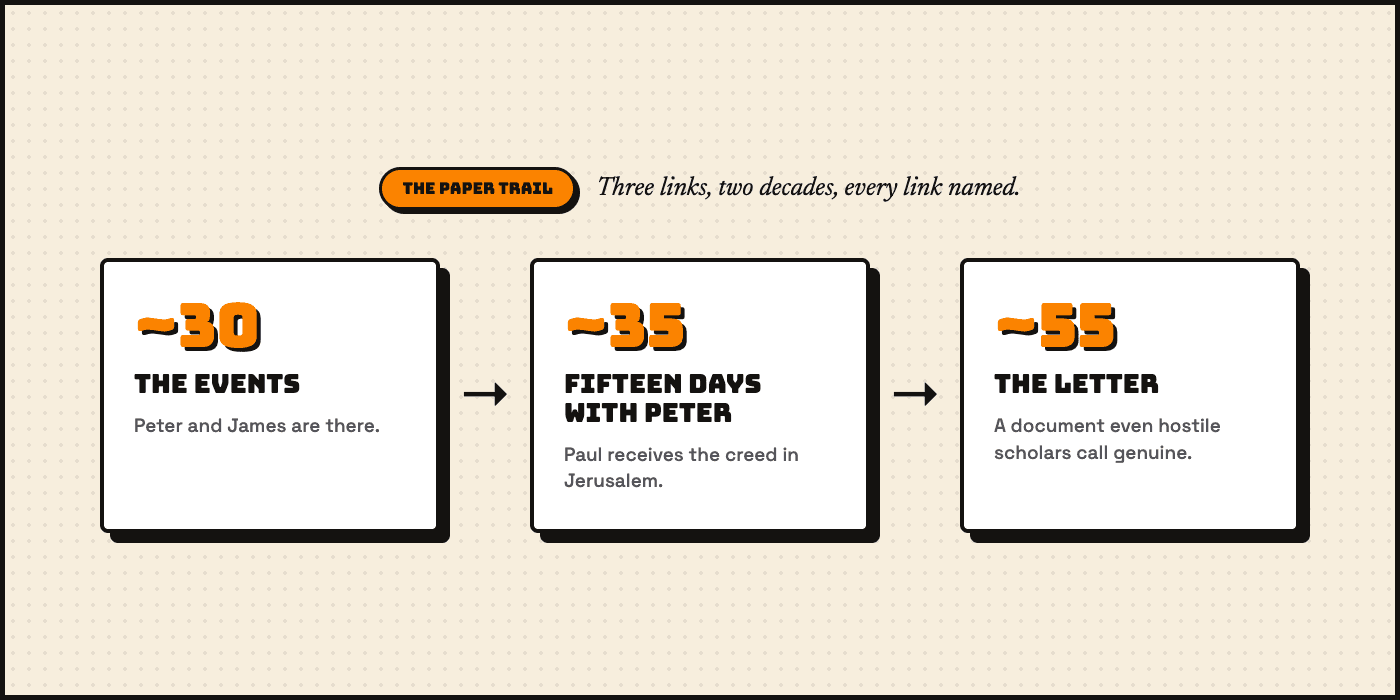
Have you noticed what this chronology does? The first visit to Peter lands around 35 or 36 AD. The majority of scholars who comment on it think this Jerusalem visit, with Peter and James, is precisely where Paul received the creed, and both of those men appear by name in the creed’s own list of witnesses. Two weeks is a long time. Fifteen days in Peter’s company is not a handshake at a conference; it is every meal, every evening, every question a famously relentless man could think to ask the lead eyewitness. And the second visit means Paul then submitted his message to the very people best positioned on planet Earth to call it false, and walked away endorsed.
Some sharp guy will catch something here, so let me raise it myself before he says “gotcha!”. In this same letter, Paul insists his gospel came “not from man, nor through man, but through a revelation of Jesus Christ” (Galatians 1:11–12). So which is it, heaven or two weeks of Peter’s cooking? The answer is both, actually, because Paul is describing two different things.
The revelation gave him his commission and his message. The community gave him the tradition, the fact-sheet of events and named witnesses he quotes in 1 Corinthians 15, and he uses the honest word for it: received. A calling and a checklist are not the same thing, and holding both is not a contradiction. But what a private revelation can and cannot establish is a question big enough to deserve its own essay, and it’s getting one. That’s Part III. Let’s not get ahead of ourselves just yet.
So we can trace the chain, because it is short enough to hold in one sentence. The events happen around 30. Peter and James are there. Paul sits with Peter and James around 35 and receives the formula. Paul writes it down in a letter around 55 that even the most hostile scholars agree is genuinely his. Three links, two decades, every link named.
The dare
And then Paul does something that, the longer I read and study it, the stranger it gets. Something no fabricator in recorded history has ever volunteered to do.
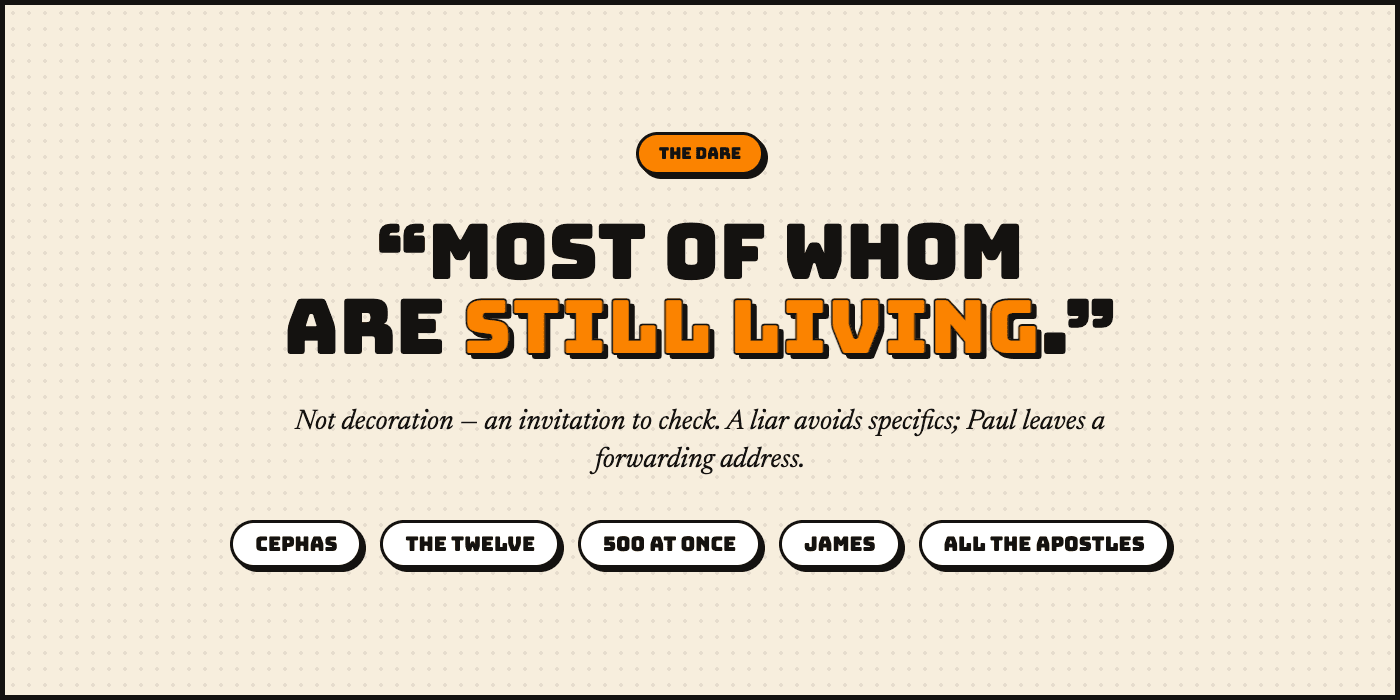
He names names. Peter. James. The Twelve. And then: more than five hundred people at once, “most of whom are still living.”
Most of whom are still living? Think about what that clause is. It is not decoration. It is an invitation to check. Paul is writing to a real congregation in Corinth, a port city buzzing with travelers, and telling them: the witnesses are alive, right now, mostly in Judea; go and ask.
To put it in modern terms, Corinth to Judea is about the distance between Toronto and Winnipeg, and that’s considering the gruelling overland journey around the Mediterranean. They didn’t walk around the Mediterranean though, they sailed through it, which would have made for a vastly shorter journey.
So, Paul is effectively handing his readers the means of his own exposure. And he is doing it in the most hostile environment imaginable, because Jerusalem in the 50s was not full of people rooting for him. It was full of the authorities who had sought Jesus’s execution, full of Paul’s own former colleagues who considered him a traitor, full of people with every motive and every opportunity to stand up and say “I knew Peter; he never claimed any such thing.” A liar avoids specifics the way a burglar avoids daylight. Paul supplies specifics like a man leaving a forwarding address.
I’ll quickly concede something obvious before someone raises it. The five hundred appear only in Paul’s letter and no other document counts that crowd for us. But that’s precisely why it matters. A man padding his story doesn’t attach a verification notice to the padding. You don’t say “most of whom are still living” about witnesses who don’t exist, in a letter travelling to a port city one boat ride from Judea where he was no longer liked anyway. Unless, of course, you’re sure of what you’re saying.
None of this, I should say plainly, still proves the resurrection happened. Five hundred people can be wrong; a creed can be sincere and mistaken. What it proves is narrower and, for the purpose of this series, sufficient: whatever Paul was doing, he was doing it inside living memory, in public, with named and checkable sources, under the eyes of enemies. That is the profile of a man reporting, not a man inventing.
The first alarm, run honestly on Paul, barely whispers.
The same detector, the other man

Now the part of the essay I promised in Part I would not be an ambush. Muhammad steps through the same machine, on the same setting, and we ask the same two questions you would have asked the person reporting the interesting events at the wedding. Were you there? Then who told you?
The Quran makes strong, specific claims about Jesus: that he was not crucified and it was only made to appear so (Surat Al-Nisā 4:157), that he was not divine, that his true message matched Islam’s. These claims concern events of roughly 30 AD. Muhammad began receiving revelations around 610. That is not twenty-five years of distance. It is nearly six hundred. What?
Here is where that thoughtful Muslim I anticipated from Part I steps in, right on schedule, and I want to give his answer its full dignity before I test it. He says: we never claimed a human chain back to Jesus. The Quran is God’s direct speech, it needs no witnesses. And for our prophet’s own life, we have the isnād, the science of chains: every hadith traced narrator by narrator back to a Companion who was in the room, every narrator’s character and memory vetted. Your point about distance is answered by revelation on one side and machinery on the other.
Take the machinery first, because it deserves the respect of being taken seriously. The isnād system is a genuine intellectual achievement; I said so in Part I and I meant it. But watch carefully what it certifies, and what it cannot. Every one of those chains terminates at Muhammad. The best chain in Bukhari, the most authentic hadith collection, reaches back to a Companion in seventh-century Arabia who heard the Prophet speak. It reaches him and stops, because there is nowhere further back to go. And the canonical collections that preserve these chains were themselves written down some two hundred years after Muhammad’s death, with Bukhari’s collection completed around 846. Two centuries from Muhammad. More than eight centuries from Jesus.
So for claims about what Muhammad said and did, the isnād may be a real instrument, argued over by scholars but real. For claims about what happened outside Jerusalem in 30 AD, it is not a weak instrument. It is no instrument at all. There is no chain of narrators reaching back to Golgotha, no Companion who interviewed a witness of the crucifixion, no six-century isnād for the events of Jesus’s life, because there was never anyone at the far end to chain back to. The machinery Muslims rightly take pride in was never even pointed at the question this series is asking.
Which leaves the other half of the answer: the Quran needs no witnesses, because it is revelation. Even if that were true (I don’t believe it is), notice what has just happened to the argument, because this is the whole essay in one motion. The objection against Paul was historical: he was too far from the events to know. The defense of Muhammad’s Quranic Jesus is theological: distance doesn’t matter when God is speaking. Both cannot be your standard at the same time. If distance from the events disqualifies a source, then a six-hundred-year gap with no witnesses doesn’t merely fail the test Paul was given; it fails it by a factor of thirty, against the unanimous testimony of every source from the period (including the testimony of Jesus’ own brother, who led the church that proclaimed it). And if distance doesn’t matter, because revelation overrides it, then the lateness charge against Paul was never a real objection to begin with, and it should be withdrawn, publicly, wherever it is still being preached.
That is the detector doing exactly what we built it to do. The alarm that was supposed to condemn Paul barely sounds for him, twenty-five years, named living witnesses, a checkable chain. The same alarm, pointed at Muhammad’s six-hundred-year gap, goes off like a fire drill. And the only way to silence it is to reach over and switch off the machine? No, we don’t do that here.
What we’ve banked

Let me be clear about what this part has and hasn’t done, because the series only works if I don’t oversell it.
It has not proven the resurrection. It has not proven Islam to be false. It has simply done one narrow thing very well: it has retired the lateness objection. Anyone who reads this and still says “Paul was too late to know” now has to explain why twenty-five years disqualifies a man who named living witnesses, while six hundred years is no obstacle at all for the other guy. If they can explain that without special pleading, I genuinely want to hear it. I don’t believe they can. I am, in fact, certain that they can’t.
One alarm down, three to go. Next time, I’ll take on the second charge, that Paul never met Jesus and had no contact with him, only a private vision. That one runs deeper than distance, because it asks what kind of experience is allowed to found a faith. And it turns out the cave and the road have more to say to each other than either side is comfortable admitting.
“Same detector. Same setting. Bring a friend, and maybe some popcorn too.”
Newsletter coming soon
Email signup is not connected yet, so we will not pretend to collect your address. Follow the channel for new essays and episodes in the meantime.
Follow on YouTube