
One Standard, Two Prophets — Part I
There is a sentence that has shaped how a great many Muslims read the New Testament, and it is short enough to fit on a placard:
“Christianity is not the religion of Jesus. It is the religion of Paul.”
You will not hear it from every Muslim, and not every time. But sit in on enough conversations, or scroll far enough under any video about the crucifixion, and it surfaces with a kind of gravity, as if the smaller objections had been orbiting it all along. The idea here is that Jesus preached a clean, strict monotheism a Muslim would find familiar, and that after he was gone, a latecomer named Saul of Tarsus rebuilt that message into something Jesus would never have recognized: the cross, the blood, God in human flesh, salvation by belief rather than obedience (this is partly why Muslims claim Jesus was a Muslim, which I debunked in this essay). On this telling, the whole structure of my faith is not revelation at all. It is the improvisation of one brilliant, difficult man who arrived late and somehow ended up holding the pen and using it a bit better than those who were closest to Jesus himself.
The name most attached to this argument is Ahmed Deedat, the South African preacher and debater who, from the 1970s until his death in 2005, did more than perhaps anyone to popularize Muslim apologetics against Christianity. He filled halls, gave away booklets by the millions, and trained a generation of debaters who followed him. In one of those booklets, Crucifixion or Cruci-fiction? (which I took my time to read), he called Paul “the real founder of Christianity.” He did not invent the idea, and he is nowhere near the only one who holds it. Bilal Philips sharpened it, Shabir Ally and Zakir Naik carried it forward, and by now it is less one man’s thesis than a shared inheritance passed down through the da‘wah tradition. Deedat simply packaged it for ordinary people better than anyone before or since. You can still find PDF copies of it online.
I am a Christian, and I am not going to pretend otherwise to sound more neutral than I am. I believe Paul. I believe the gospel he preached is true, that Jesus was crucified and rose, and that the man from Tarsus was telling the truth about what he saw. So I have every reason to want the argument against him to be weak. Unfortunately it isn’t.
I will spend this series showing why it fails, but I will not begin by tearing it down. I will begin by building it up, because an argument you are afraid to state at full strength is one you quietly suspect might be right.
The Steelman: the case against Paul, at full strength
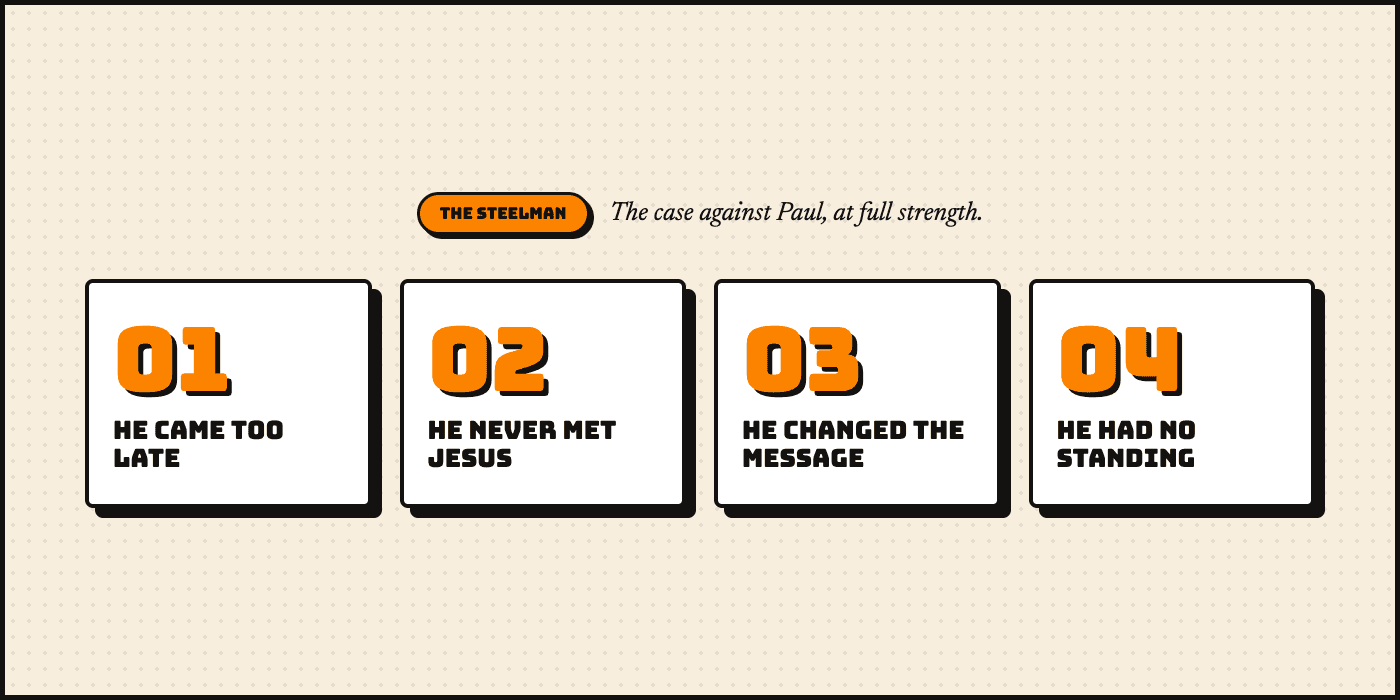
The Muslim case against Paul rests on four claims. Not one of them is foolish, and each deserves its strongest form.
One: he came too late. The events at the center of the dispute, the public life and death of Jesus, which the Gospels record, happened around 30 to 33 CE, in Galilee and Jerusalem. Paul was not there for any of it. He enters the story only afterward, and by his own account he enters it first as an enemy, viciously hunting down the followers of Jesus until a vision on the Damascus road turned him around. So, the single most influential interpreter of Jesus is a man who, during Jesus’s entire public life, was either absent or actively hostile. In a courtroom, in journalism, in ordinary history, we lean hardest on the witness who was present when it happened, because that witness can be checked against the event itself. Paul cannot be. He is interpreting a life he did not see, and a latecomer interpreting events he did not witness is precisely the person a careful mind slows down to examine and perhaps distrusts.
Two: he never met Jesus. Grant that Paul arrived late; the disciples at least had the years of direct instruction, the shared meals, the private explanations of mysterious parables, the long walk down the same roads. Paul had none of it. Nada! He never studied under Jesus for a single day. And when he tells us where his message came from, he says plainly that he did not receive it from any man, but through revelation (Galatians 1:11–12). For three years he preached this revelation without checking it against any of the disciples, until he finally went to Jerusalem and saw Peter, and later James. Sit with how that lands on a Muslim ear. The man reshaping the faith grounds his authority not in the people who knew Jesus, but in a private disclosure that came to him alone. In any other field we would notice the gap between the apprentice who trained beside the master and the stranger who says the master appeared to him afterward and told him things the apprentices had somehow missed.
Three: he changed the message. This is the heart of the objection, and it is stronger than Christians like to admit. The charge is not that Paul added a footnote. It is that he swapped the engine. When a rich man asks Jesus how to gain eternal life, Jesus tells him to keep the commandments (Matthew 19:16–17). Jesus says he came not to abolish the Law but to fulfill it, that not the smallest letter will pass from it until all is accomplished (Matthew 5:17–18). He is circumcised, keeps the Sabbath, and worships in the Temple. Then comes Paul, who writes that a person is justified by faith apart from works of the Law (Romans 3:28), that Christ is the end of the Law (Romans 10:4), that the written demands of the law were nailed to the cross (Colossians 2:14). He tells Gentile converts they need not be circumcised, the very sign of the covenant God gave Abraham. To a Muslim this is not growth, it is reversal: the prophet (if we’re calling Jesus a prophet for argument’s sake) upheld the Law, and his most famous interpreter appears to have dismantled it. Then add the greater leap. The Jesus who in the Gospels prays to God and calls himself God’s servant becomes, in the theology Paul helped shape, God himself in the flesh, the one claim Islam exists to deny. If you already believe Jesus came to call people back to obeying the “one God,” then Paul certainly looks like a man who founded a different religion (or even a cult) and kept the old logo.
Four: he had no standing. Who was Paul to do any of this anyway? He was not one of the Twelve. He was not appointed by Jesus during his lifetime (they never even physically met). He began as a persecutor, and his entire commission rests on an appearance of the risen Christ that, by his own account, he alone received. Once inside the movement he does not defer to the men who actually knew Jesus; he corrects them openly. He tells us himself, almost proudly, that he opposed Peter to his face (Galatians 2:11). The same Peter that Jesus had named the rock? A Muslim raised to trust a hadith only as far as its chain of narrators has been trained to hear a claim like Paul’s and flinch. It’s the same instinct that makes him ask of any hadith: who’s in the chain, and does it actually reach someone who was there with Mohammad? Paul, by his own account, has no chain. Islam runs authority through a traceable human chain back to the source, and Paul cuts against that instinct entirely. His gospel, he insists, came “not from men nor through man” (Galatians 1:1, 12). He is, to put it in terms we all recognize, the person who joins the group project in week ten, did none of the fieldwork, and somehow ends up delivering the final presentation while the people who did the research sit quietly in the back.
I want to give all of that its weight, because we are too quick to wave it off. Thirteen of the twenty-seven books of the New Testament carry Paul’s name, and no single human being shaped Christian theology more. A Muslim who opens that book, counts the pages, and notices that its most prolific author never met the man at its center has not made an error. He has seen something true and drawn reasonable suspicion from it.
Fairness runs both ways, though: it’s sometimes claimed by Muslim scholars and the da‘wah bros that Paul shows no real interest in what Jesus actually said, but he does quote him directly on divorce, on the Last Supper, and on how ministers should be supported. So the silence argument is strong but not entirely true.
The reflex I am setting aside

We Christians have not always answered this well. Two reflexes tempt us, and I will name them once and then leave them behind.
The first is mockery. We treat Deedat as a punchline, reach for the flimsiest version of the objection, knock that over, and take a bow. I understand the appeal. It feels like winning. But the Muslim watching does not conclude that Paul has been vindicated; he concludes that we could not be bothered to understand him, and he is usually right to make that conclusion.
The second is quieter. Instead of answering the question, we diagnose the person asking it: “You only doubt Paul because the Quran already told you the crucifixion did not happen.” Sometimes that is even true of a given individual. But it changes the subject from is the objection sound to why is he asking it, and in doing so it concedes the very thing we are afraid of, that the criteria might not survive being tested.
So I will test them instead. That is the last I will say about my own fairness. The proof of it is the argument, not the promise.
The standard I did not build
Here is the rule that governs everything. I am not going to invent a test that Paul happens to pass. I am going to borrow the Muslim’s own test, those four criteria, and run it exactly as written, on both men.
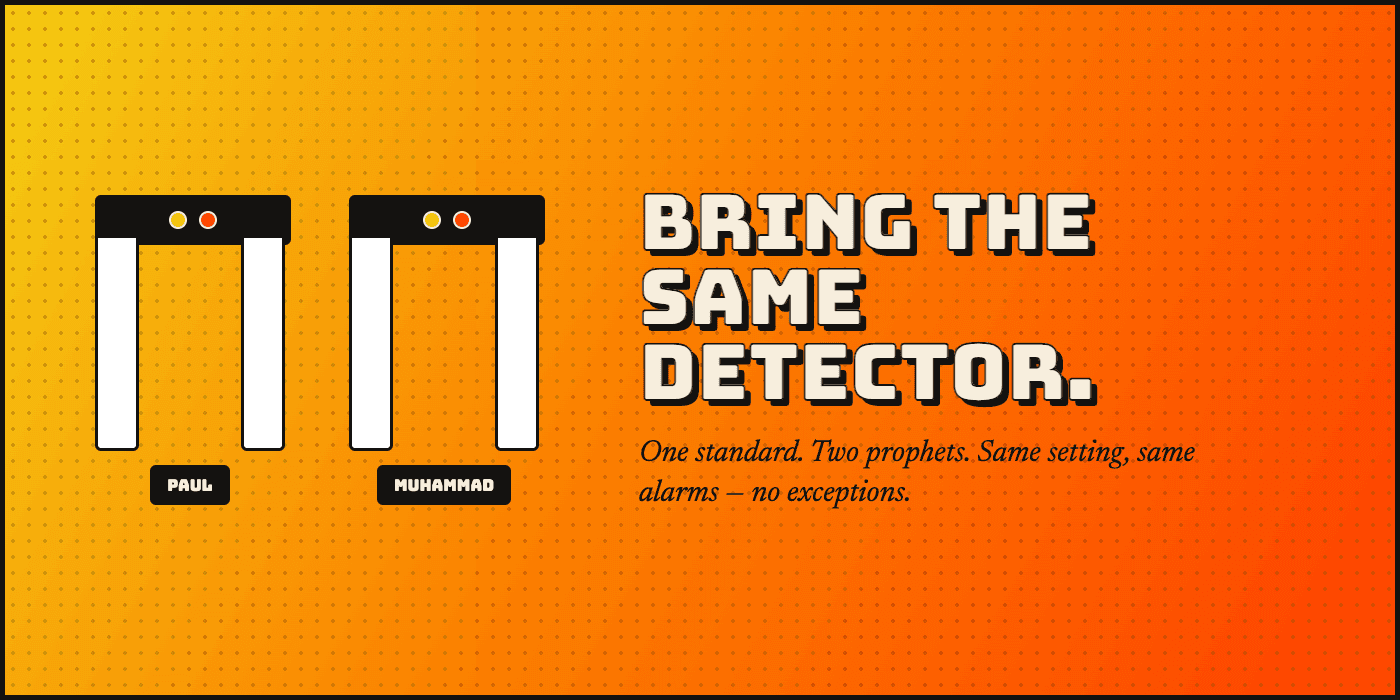
As you probably already know, I love analogies, so here goes another. If you’ve gone through airport security, you’ll know that the metal detector gate is gloriously stupid, and that is its entire virtue. It does not know your name or your religion; it reacts to metal, and nothing else. Now, the first man walks through, the metal detector shrieks, the guard pulls him aside for a search. Fine. Then the next passenger, who happens to be an old friend of the guard, walks through, and the machine nearly lifts off the floor, lights flashing, alarm louder than before. The guard then looks up, grins, reaches over, switches the machine off, and waves his friend through with a pat on the shoulder. In that instant everyone still in line realized something new. The machine was merely theater, and simply handed the guard a tidy excuse to search a man he already wanted to search, and it got switched off for the man he wanted to protect.
That is the test for this series. Paul walks through the four-part detector first, on the evidence that exists for Paul. Then Muhammad walks through the same detector, at the same setting, on the evidence that exists for Muhammad. If the alarms that condemned Paul fall silent for Muhammad, where the historical distance is far greater, then those alarms were never the real reason Paul was rejected.
I will bind myself with one constraint so the test stays honest. When I defend Paul, I will use only the seven letters that essentially no serious historian, believing or skeptical, disputes are genuinely his: Romans, First and Second Corinthians, Galatians, Philippians, First Thessalonians, and the short note to Philemon. They were written around 50 to 60 CE, two to three decades after the crucifixion. I will not lean on the disputed letters or on the book of Acts where it counts, because the moment I do, the objector gets a free exit: that letter is a forgery, that speech is Luke putting words in Paul’s mouth. I am closing that exit before we begin.
The word I will say before you do
I am a debater, so I know a careful reader is already reaching for a Latin fallacy phrase, so let me say it first. Tu quoque. “You too.” The move of answering a charge by flinging it back at the accuser. You think Paul came late and changed the message? Muhammad came six centuries later and changed more.
Stated that way, it really is a fallacy, and I would deserve to be dismissed for it. If an embezzler accuses me of stealing, shouting “you’re a thief too!” does not put a dollar back or make me honest. Whatever is or is not true about Muhammad cannot reach back and make Paul’s gospel true.
So I am making two separate claims, and I will keep them separate for the whole series.
The first is a direct defense of Paul, standing on its own evidence. He wrote within living memory. He named witnesses who could have stood up and exposed him. He took his gospel to the very men who had walked with Jesus and came away endorsed rather than thrown out. That would be true or false regardless of Muhammad, and it is where most of my work will go.
The second is an audit of the criterion. When someone runs a rule hard against Paul and then quietly shelves it for Muhammad, where it would bite deeper, the simplest explanation is that the rule was never the real reason for the verdict. That does not prove Paul innocent. It simply proves the standard was doing other work than the one advertised. The defense of Paul carries the weight; the audit is only a lever, and I will not ask the lever to do the weight’s job.
One reader deserves particular honesty here. Some Muslims will say Muhammad’s authority never rested on a lone vision in a cave at all. It rests on something sturdier: a documented chain of named people, one telling the next, all the way back to someone who was actually there (what they call an isnād). Paul, they’ll say, has nothing like that. So comparing the two is comparing a private vision to a paper trail, and that’s not a fair fight.
I take that seriously. It’s a real objection, not a slogan, and scholars have spent decades arguing over how far those chains actually hold up. I’m not going to answer it here. I’m going to answer it properly in Part II, when we get into the question of distance, and the answer will come down to one thing: does that chain actually reach back to someone who knew Jesus, or does it just reach back to Muhammad’s own century, six hundred years after the fact? I’m flagging it now so it doesn’t feel like I sprang it on you later.
My real ask — a small ask
So here is my request, and it is for the Muslim reader first, since he is the one I am writing for. I am not asking you to abandon anything. I am not asking you, in this essay, to reconsider your prophet, your book, or your faith. That is a far larger conversation, and this is not the room for it (yet). I am asking something small enough that a fair mind can actually grant it: hold your own standard steady. Take the four criteria you have always aimed at Paul, and refuse to dim them for anyone, Muhammad included. If, run evenly, they clear Paul and point somewhere uncomfortable, do not look away from where they point. And if they genuinely convict Paul on grounds that survive being turned on everyone, then I will have failed, and you should say so.
That is the whole deal. One standard. Two prophets.
I believe the resurrection happened. I would rather be honest about where I stand than hide it behind a neutral voice. But notice that nothing I have asked of you here requires you to believe it yet. I have asked for something you can grant while still disagreeing with me about everything that matters most, and that is on purpose.
Next time we take the loudest of the four charges, the one about lateness, precisely because it is supposed to be Paul’s fatal weakness. Run the actual numbers and it turns into his strongest defense. Paul wrote within a couple of decades of a very public execution, quoting a creed older still, and he did the one thing no forger ever volunteers to do. He named names. He named people who were still alive. And he all but dared his readers to go and ask them. We will see who, by the standard of distance, was really in a position to know.
“Bring the same detector when we start measuring next time.”
Newsletter coming soon
Email signup is not connected yet, so we will not pretend to collect your address. Follow the channel for new essays and episodes in the meantime.
Follow on YouTube